
What to Do in Marrakech: 10 Fun Things
There is no shortage of fun things to do in Marrakech, as the city offers history, architecture, culture and local traditions almost everywhere you walk. Ancient palaces are next to busy markets; peaceful courtyards are hidden behind crowded streets. Whether for a few days or a longer trip, Marrakech has many places that help visitors understand the rich story of this famous Moroccan city.
Explore the Palaces of Marrakech
The historic palaces are among the most impressive attractions in Marrakech. They show the wealth of former rulers and the remarkable skills of craftsmen who worked hundreds of years ago. Some palaces survive only as ruins, while others still display much of their original beauty.
El Badi Palace and the Glory of the Saadian Period
El Badi Palace was built during the late 16th century by the Saadian Sultan Ahmed al Mansour. Its name means “The Incomparable,” which gives an idea of how magnificent the palace was intended to be. Historical sources describe a residence decorated with materials brought from different countries. Marble, precious woods, and expensive decorations were used to show the power of the ruler.
The palace was a reception area where foreign visitors could see the wealth of the Saadian dynasty. Marrakech was then an important political and commercial center and the palace reflected that importance.
With the death of Ahmed al Mansour, the fate of the palace changed dramatically. The precious materials were removed and reused in buildings around Morocco. The palace fell into decay as the Saadian dynasty waned.
Today you can see the remains of what was once a massive complex. Many decorations were lost, but the size of the building is still impressive. The vast courtyards, the immense walls, and the subterranean areas help visitors to imagine how fabulous the palace was.
One of the most interesting sights at El Badi Palace is the population of storks. Their nests sit on top of the old walls and towers. The birds have become part of the character of the site and are often noticed before visitors even enter the ruins.
Bahia Palace and Its Elegant Architecture
El Badi Palace exemplifies lost grandeur; Bahia Palace exemplifies preserved beauty. It was built in the 1860s by Si Moussa, a powerful grand vizier. In the early 1900s, his son added on to the palace, making it one of the most beautiful residences in Morocco.
Bahia Palace covers about 8 hectares and has around 150 rooms. Only a part of the complex is open to visitors, but even these parts show an impressive level of craftsmanship.
As visitors walk through the palace, they will see colorful zellige tilework, carved cedar wood ceilings, stained glass windows, marble floors, and decorative courtyards. Each space was meant to wow visitors, to show off wealth.
The Large Riad is often considered the star of the complex. This section of the park, built in 1867, combines elegant architecture with tranquil gardens. The orange trees, jasmine plants, and shaded walkways create a tranquil atmosphere that seems a world away from the busy streets outside.
Many of the city’s historic sites are simply ruins, but Bahia Palace lets people see the decorative details that made Moroccan palaces so famous. Light pours in through open courtyards and is reflected off colorful surfaces, creating ever–changing views.
Because of its beauty and historical significance, Bahia Palace remains one of the most visited attractions in Marrakech.
Visit Ben Youssef Madrasa
Ben Youssef Madrasa is one of the most famous monuments in Morocco. Originally founded in the 14th century and expanded during later periods, it served as an Islamic school for many generations.
For several years the madrasa was closed for restoration work. Today it is once again open to visitors and continues to attract people from around the world.
The building is considered one of the best examples of Moroccan architecture. Intricate plaster carvings cover the walls and archways. The complex is adorned with geometric tile patterns. The cedar wood decorations show the craftsmanship of artisans who lived centuries ago.
The heart of the madrasa is the central courtyard. In the center is a reflective pool, surrounded by elaborate facades and elegant arches. This area is the part of the monument that is photographed most often.
At its peak, the school had around 900 students. On the upper floors you can still see the small rooms for students, which helps visitors to imagine the daily life of the institution. Young scholars came here to study religion, law, and other subjects important for Islamic education.
The Ben Youssef Madrasa is especially intriguing for the way it balances beauty with function. It was not erected as an ornament alone. It also served an educational function and played an important role in the intellectual life of Marrakech.
Visit Museums Across Marrakech
Museums provide a different perspective on the city. They help explain how Moroccan society developed and preserve objects connected with daily life, art and history.
Several museums deserve special attention:
- Maison de la Photographie presents photographs, postcards, newspapers, and historical documents showing Moroccan life between 1870 and 1950.
- Musée de Marrakech occupies the historic Dar Menebhi Palace and combines architecture, traditional objects, and art exhibitions.
- Dar Si Said Museum is considered one of the oldest museums in Marrakech and contains collections of antiques, weapons, musical instruments, jewelry, and decorative arts.
Many visitors choose museums during the hottest hours of the day. Besides the exhibitions themselves, the historic buildings that house these collections are often attractions in their own right.
Get Lost in the Medina
The Medina is the old city of Marrakech and one of the most interesting urban areas in Morocco. It is surrounded by ancient walls and has countless narrow streets, markets, workshops, homes and religious buildings.
It’s nearly impossible to get lost here. Digital maps or not, visitors often find themselves taking unexpected turns down small alleyways and hidden passages.
It’s part of what makes Medina unique. Maybe there’s a local bakery around the corner. Another artisan goes around him, using methods that have been inherited from generations. Suddenly, behind busy streets, little courtyards appear, creating moments of calm inside the maze of the old city.
A visit to Medina gives visitors a taste of everyday life in Marrakech. The district is more than just a place to visit. It’s still a living neighborhood, where people work and shop and socialize every day.
Many travelers consider wandering through these historic streets one of the most memorable and enjoyable things to do in Marrakech because every walk reveals something different.
Experience a Traditional Hammam
A hammam is one of the oldest traditions still practiced across Morocco today. For many local people, visiting a hammam is not only about cleanliness but also about relaxation and social life. Public bathhouses have been part of Moroccan culture for centuries and remain popular in many neighborhoods.
The experience usually begins in a warm steam room. After spending some time there, visitors receive a deep scrub using a special glove known as a kessa. Traditional black soap is often used during the process. The treatment can feel stronger than many visitors expect, but afterwards the skin feels noticeably refreshed.
Traditional and Modern Hammams
There are different hammam experiences in Marrakech. Neighborhood hammams tend to be smaller and more traditional, and are often used by local residents. Luxury spas have private rooms, extra treatments, and state–of–the–art facilities.
In either case, visitors get a feel for an important aspect of daily life in Morocco. It may sound strange at first, but many travelers say it’s one of the most memorable things they do while in the city.
Visit the Tanneries and Learn an Old Craft
For hundreds of years, Morocco has been an important industry in the production of leather. The tanneries of Marrakech carry on this tradition, working animal hides with techniques that have not changed much over the years.
Workers clean, soften, dye, and treat leather before it is fashioned into bags, belts, shoes and other products sold throughout the Medina. A visit to the tanneries provides a glimpse into the labor that makes these products possible.
It is a difficult process, requiring considerable skill. These big stone vats are filled with natural substances at different stages of production.
The smell of the tannery area can be strong but many visitors think the educational value is worth the experience. It provides a glimpse into a traditional craft that remains important to the local economy.
Visit Jemaa el Fnaa and Koutoubia Mosque
Jemaa el Fnaa is the most famous public square in Marrakech and one of the best known places in Morocco. Throughout the day the area changes constantly. Market sellers, food vendors, performers, musicians, and visitors create an atmosphere unlike anywhere else in the city.
In the evening the square is especially animated. Smoke rises from the food stalls, crowds grow bigger and the energy of the space grows stronger. A lot of tourists like to sit in the rooftop cafes nearby and get a better view of the action down below.
For visitors planning their first experience, several approaches can help:
- Walk around the edges of the square before entering the busiest areas
- Visit during both daytime and evening to see different atmospheres
- Compare food stalls before choosing where to eat
- Use rooftop terraces to enjoy panoramic views
- Take time to observe daily life rather than rushing through the area
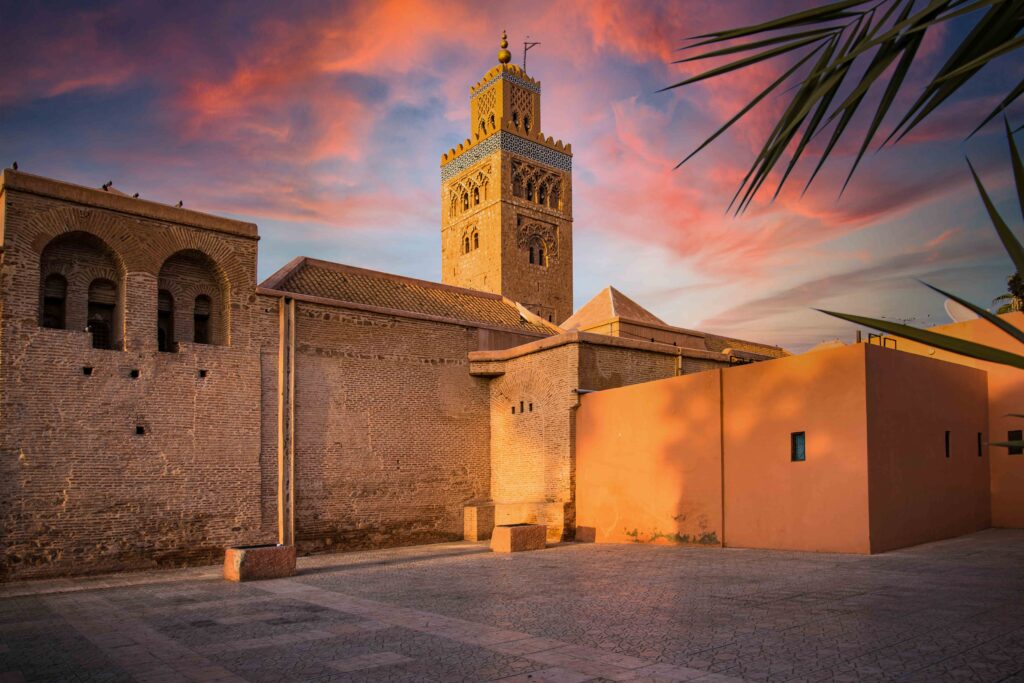
A short distance away stands the Koutoubia Mosque the most famous landmark in Marrakech. Built during the 12th century, the mosque is recognized by its impressive minaret. Rising 77 meters above the city, it remains visible from many locations throughout Marrakech.
Other Historic Attractions and Garden Escapes
For those with more time, it is possible to continue exploring some of the other important landmarks of Marrakech. The Saadian Tombs are one of the most important historical sites. After constructing the El Badi Palace, Sultan Ahmed al Mansour transformed an existing cemetery into a magnificent royal necropolis.
The complex contains richly decorated chambers featuring marble and detailed ornamentation. Historical records indicate that more than 66 princes were buried here along with approximately 100 officials, family members, and other important figures connected to the Saadian dynasty.
For travelers looking for a quieter atmosphere, gardens provide a welcome contrast to the busy Medina. Le Jardin Secret occupies a restored 19th century palace complex and contains carefully maintained Islamic and exotic gardens.
Another well–known attraction is Majorelle Garden. Created during the 1920s by French artist Jacques Majorelle, the garden became famous for its striking blue color, now known internationally as Majorelle Blue. Later restored by Yves Saint Laurent and Pierre Bergé, the garden remains one of the most visited sites in Marrakech.
Together, these places reflect the diversity across the city. The city’s identity is marked by the existence of palaces, schools, museums, religious places, gardens, and traditional neighborhoods. Visitors to these sites find out why the city continues to attract visitors from all over the world and why these remain some of the most fun things to do in Marrakech.